
Bullion reaches a three-month high as the conflict involving Iran, a hawkish Federal Reserve, escalating tariffs and record central bank accumulation reshape safe-haven demand, portfolio allocation and long-term precious metals investment strategy.
SINGAPORE / ACCESS Newswire / September 1, 2026 / Gold futures for year-end delivery open at $4,710.10 per troy ounce this week, the metal up roughly 15% over the current month. That run puts bullion on course for its strongest monthly showing in nearly three decades. Sycamine Capital Management Pte. Ltd. reads it as a tight convergence of renewed conflict in the Gulf, a hardening line on inflation from the Federal Reserve and official-sector buying without recent precedent.
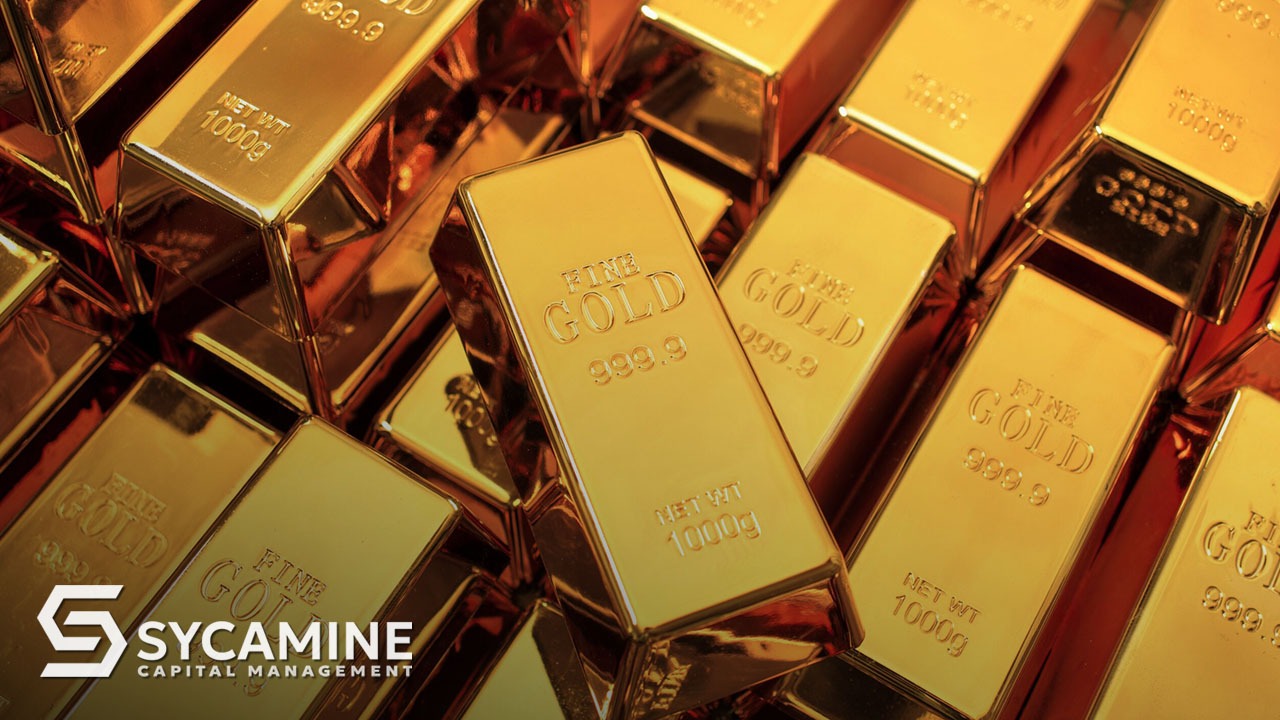
Bullion settles at $4,587.75 per troy ounce in the latest session, down 0.28% on the prior close and short of the three-month high. That high arrives earlier in the week, and the wider trend holds firm. A rise of 12.83% over the preceding month sits alongside a gain of 33.01% against the same point a year earlier.
Gold sets an all-time high near $3,874.1 an ounce last spring, as investors retreat from riskier assets during the trade dispute. That level eclipses an inflation-adjusted record of $3,763.4 set more than four decades ago. A gain of more than 60% follows over the course of the succeeding year, carrying the metal to $4,799.5. A retreat of roughly 10% comes over the weeks that follow.
Joint United States and Israeli strikes against Iran earlier in the year sharpen regional tensions and send Brent crude to $126.2 a barrel. The climb in energy costs revives inflation concerns at the major central banks. A Federal Reserve once expected to cut twice before the close of the year now leans towards at least one increase. Chair Kevin Warsh places price stability at the front of the mandate, and traders reposition ahead of his Jackson Hole address, lifting bullion to its highest in more than three months.
The tariff programme out of Washington compounds the picture, the effective United States rate climbing from 2.5% to 27% within months last year. Near-universal levies of 25% fall on Canada and Mexico, while duties on Chinese goods escalate to 145% against retaliation of 125% on American imports. Import costs pass through to consumers and the dollar weakens as the drag on growth becomes apparent.
Gold adds 3% to about $4,936.7 an ounce after the Treasury Department confirms it will at least double buybacks of longer-dated notes and bonds. Maximum repurchases across 10 to 30-year maturities rise from $2.2 billion to at least $4.4 billion. The 30-year yield eases towards 5.2% from 5.34%, its highest in almost two decades. Lower yields cut the opportunity cost of bullion while renewing questions over fiscal strain.
Official-sector demand supplies the structural underpinning that earlier cycles in the precious metals market conspicuously lacked. The People’s Bank of China records its largest monthly bullion addition in nearly two years over the past month, while net gold imports through Hong Kong rise by around 11% on the preceding month. That acceleration ranks as the most instructive signal available to allocators in the assessment of Sycamine Capital Management’s Senior Vice President, Jerry Farrington, who describes sustained central bank buying as “the one source of demand that does not chase a price and does not flinch when it moves.”
The low to negative correlation gold holds with the major asset classes gives it a role few instruments replicate. Macroeconomic and company-specific factors that move equities and credit leave the metal largely untouched. The World Gold Council estimates that a strategic allocation of 5% to 10% may improve risk and return ratios over a two-decade horizon.
Research into balanced portfolios over the past decade puts the weighting that lifts risk-adjusted returns at 4% to 15% in gold. The optimal mix sits near 17% against 50% equities and 33% bonds. Positions bought on margin sharpen the exposure: a decline of $1.1 in the price removes $110.7 from a margin account, and a 4% fall in spot wipes out an initial commitment of $5,977.2. Farrington points to that asymmetry as the reason discipline outranks conviction at this stage, observing that “volatility is not a flaw in this market; it is the price of admission.”
Currency debasement remains the clearest argument for the metal, and a decade of runaway British inflation supplies the sharpest illustration. Gold moves from $19.7 to more than $408 per troy ounce across those ten years. Annual returns over the five decades since Bretton Woods collapsed range between 8.1% and 10.3%, against roughly 3.9% for consumer prices. J.P. Morgan Global Research expects an average of $6,641.3 an ounce by the final quarter of this year, and $6,973.4 by the close of next. Upgraded institutional targets run from $5,977.2 to as high as $8,855.1 over the same horizon.
Geopolitical pressure, monetary policy uncertainty and fiscal strain continue to reshape allocation decisions. Sycamine Capital Management holds that balancing inflation protection against price risk remains the central question in portfolio construction. Volatility is intrinsic to precious metal markets, and allocating with precision separates capital protection from capital exposure.
About Sycamine Capital Management
Founded in 2008, Sycamine Capital Management Pte. Ltd. applies deep analytical expertise to keep investors ahead of shifting markets. Forward-looking research across artificial intelligence and ESG shows a capacity to identify opportunity early and help investors navigate developments still forming. Further articles are available at https://scmgt.com/sycamine-investment-focus-articles/.
Contact Person: Simon Lau (Media Relations)
Email: simon.lau@scmgt.com
Website: https://scmgt.com
SOURCE: Sycamine Capital Management
View the original press release on ACCESS Newswire


