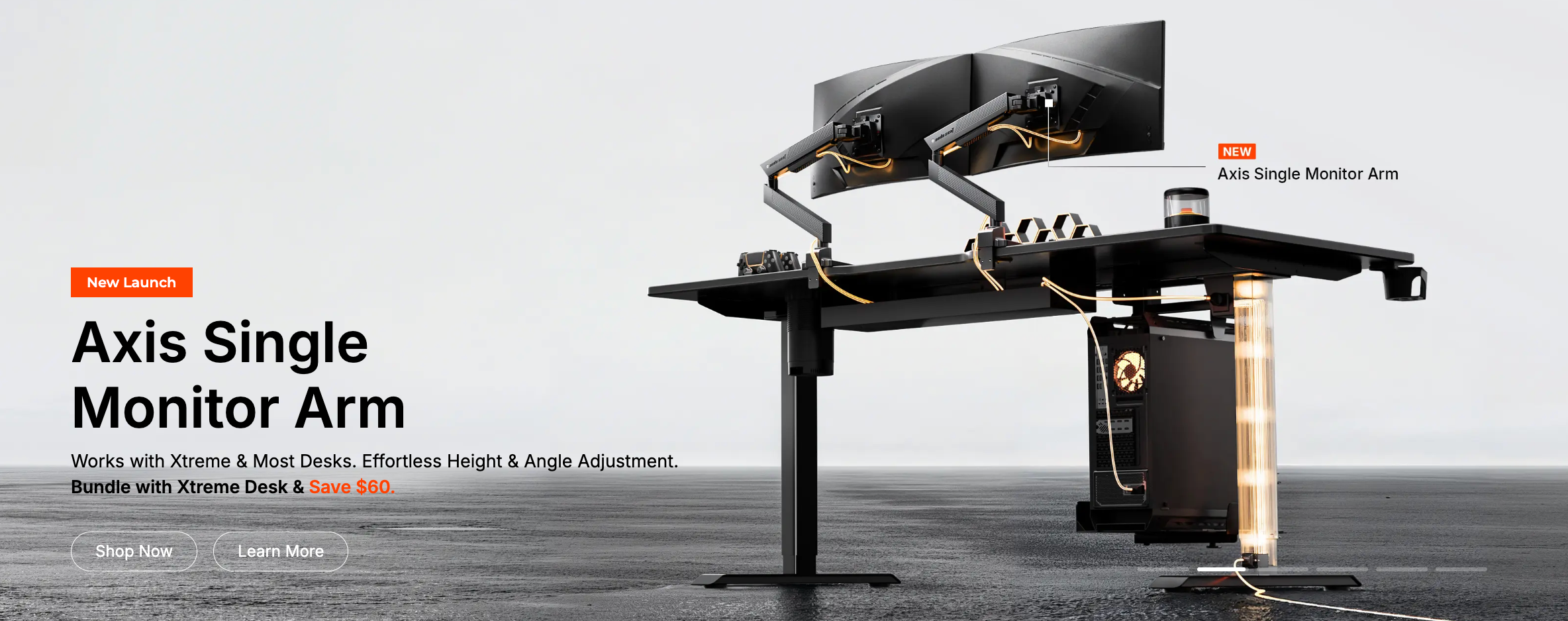
AndaSeat Explains How Motion Control and Installation Flexibility Shaped Its New Monitor Arm Series
SPOKANE, WA, UNITED STATES, July 23, 2026 /EINPresswire.com/ — Since the launch of the AndaSeat Monitor Arm Series, AndaSeat is outlining the product-development thinking behind a mounting system designed for gaming, creative, professional and hybrid workspaces.
The development brief began with a deceptively simple question: how can a monitor move freely when its position needs to change, yet remain stable when the movement stops?
That question defined the engineering direction of the series. A monitor arm is expected to perform two opposing tasks. It must reduce the effort required to change screen height, depth, angle and orientation, while also resisting unwanted drift and gradual movement after the display has been positioned.
The challenge becomes more complex when one product is expected to support monitors ranging from 17 to 34 inches and weighing from 3 to 11 kg. Different monitors can apply different loads to the arm depending on their weight distribution, depth, curvature and mounting-point location.
Rather than treating the monitor arm as a decorative desk accessory, AndaSeat developed the series as a mechanical interface connecting the display, desk and user. The resulting product combines a full aluminum-alloy structure, mechanical spring mechanism, one-way bearing head joint, quick-release VESA plate, magnetic cable covers and two desk-mounting methods.
The Development Story Started With “Move, Then Hold”
Many monitor-arm specifications focus on how many directions a screen can move. The development approach behind the AndaSeat Monitor Arm Series placed equal emphasis on what happens after the movement ends.
A monitor that is difficult to reposition may remain in one default position even when the user changes posture or task. A monitor that moves too easily may gradually shift away from the intended viewing position.
The engineering target was therefore not maximum looseness or maximum resistance. It was controlled movement within a defined load range.
The mechanical spring structure was selected to support that balance. The mechanism is designed to help counter the monitor load during adjustment, allowing the screen to be repositioned without requiring the user to lift its full weight through the entire movement.
At the same time, the structure is intended to provide sufficient holding force once the monitor reaches the selected position.
Monitor weight alone does not determine how an arm behaves. A deeper or curved display may place its center of gravity farther away from the head joint. A monitor with a different VESA mounting position may also apply leverage differently.
Supporting monitors from 3 to 11 kg therefore required the system to accommodate a range of load behaviors rather than being tuned around only one display size.
The one-way bearing head joint was incorporated as an additional point of control. Its purpose is to help the display maintain its selected angle while still allowing deliberate tilt adjustments.
Within the complete system, the mechanical spring supports the larger arm movement, while the head joint manages more precise positioning close to the monitor.
This “move, then hold” principle became the central engineering story behind the product.
Why the Material Decision Came Early
The full aluminum-alloy construction was not selected only to create a premium exterior appearance.
The structure needed to manage repeated movement, support the rated display load and maintain a streamlined profile without appearing unnecessarily bulky on the desk.
Aluminum alloy provided a balance of structural strength, material weight and form flexibility. It allowed the primary arm sections and joint housings to follow a consistent design language rather than appearing as unrelated mechanical components assembled behind the monitor.
That visual consistency mattered because an articulating monitor arm remains visible from several angles.
A conventional monitor stand is largely concealed behind the display and remains in one position. A monitor arm extends, folds and rotates through open desk space. Its joints, mounting components and cable channels therefore become part of the visible workstation.
This observation also influenced the decision to introduce eight color options: black, silver, white, red, brown, orange, green and purple.
The development team treated the monitor arm as visible workspace hardware rather than a component that must always disappear into the background. The color range is designed to coordinate with minimalist offices, gaming setups, creator studios and mixed-use home workspaces without changing the underlying mechanical specifications.
Turning Ergonomic Principles Into Movement Ranges
Public workstation guidance generally emphasizes that monitor placement should be adaptable to the user and the task.
The U.S. Occupational Safety and Health Administration recommends positioning the primary monitor directly in front of the user and states that monitor support surfaces should allow adjustments to viewing distance, tilt and rotation. The Canadian Centre for Occupational Health and Safety also addresses viewing distance, screen angle, portrait orientation and the positioning of multiple displays.
The engineering task behind the AndaSeat Monitor Arm Series was to translate those broad positioning needs into a practical range of movement.
The finished arm provides tilt adjustment from -25 degrees to +90 degrees, swivel adjustment from -90 degrees to +90 degrees and 360-degree screen rotation.
The upper arm can rotate through 360 degrees, while the lower arm provides plus-or-minus 90-degree rotation. Full arm extension reaches 595 mm, and the vertical positioning range extends from 210 mm to 485 mm.
These ranges support several common screen-position changes.
A display can be moved closer during detailed editing or document review and moved farther away for a wider viewing field. It can be raised to correspond with a different seating position, turned toward another person for shared viewing, or rotated into portrait orientation for vertical media, coding, communication feeds or long documents.
The objective was not to add movement directions as isolated features. Height, viewing distance and screen angle frequently need to change together.
A monitor that moves upward may also need to move backward. A screen rotated into portrait orientation may require a different viewing distance. A display turned for collaborative viewing may require both swivel adjustment and arm rotation.
The product was therefore developed as an interconnected positioning system rather than a collection of independent hinges.
Compatibility Was Designed Around the Installation Process
Compatibility presented another development challenge.
A mounting system has limited practical value if initial installation requires unnecessary disassembly or if replacing a monitor means rebuilding the entire arm.
The Video Electronics Standards Association develops and supports open display-interface standards used throughout the PC, workstation and consumer-electronics industries. The AndaSeat Monitor Arm Series supports the commonly used 75 × 75 mm and 100 × 100 mm VESA mounting patterns.
AndaSeat paired this compatibility with a quick-release VESA plate.
The plate separates the monitor-attachment stage from the full arm assembly. It can first be secured to the back of the display and then connected to the arm. The same structure is intended to make later monitor replacement, maintenance or workspace upgrades more manageable.
The connection between the arm and desk was approached in a similar way.
Desks vary in thickness, edge profile and access to mounting openings. Some users also need a removable installation, while others prefer a more permanent connection through the desktop.
The series therefore includes two installation methods.
The desk clamp mount supports desktop thicknesses from 10 to 40 mm and is intended for common gaming desks, home workstations and office desks.
The grommet mount supports desktop thicknesses from 10 to 70 mm and provides an alternative for desks with an existing cable opening or dedicated mounting point.
These options reflect a broader development principle behind the series: installation flexibility should be part of the product architecture rather than depend on improvised adapters added after purchase.
Cable Management Became a Moving-Parts Problem
Cable management is frequently treated as a cosmetic step completed after a monitor has been installed.
An articulating arm changes that assumption because power, HDMI, DisplayPort and USB cables must follow the screen as the arm extends, rises, folds or rotates.
The development question was therefore not only how to conceal the cables. It was also how to keep them accessible when the workstation changes.
AndaSeat integrated removable magnetic cable covers along the arm. The covers are designed to organize and conceal the main monitor connections while allowing them to be reopened when a cable needs to be added, replaced or rerouted.
This avoids turning the cable channel into a permanent enclosure that becomes inconvenient after the first installation.
The magnetic cable covers also support the broader maintenance logic of the product.
The quick-release VESA plate addresses monitor installation and removal, while the magnetic covers address changes to the display connections. Both features are intended to reduce the number of steps involved when a workstation is modified.
This consideration is particularly relevant to gaming and creator environments, where a monitor may later be connected to a docking station, capture device, laptop, console or replacement desktop system.
The arm was developed around the expectation that the first cable arrangement may not be the final one.
Recovering Desk Space Without Enlarging the Desk
Another design objective came from the amount of usable surface occupied by conventional monitor stands.
OSHA’s workstation guidance states that a desk should provide enough room for the monitor to be positioned directly in front of the user at an appropriate viewing distance. It also notes that a desk should accommodate different working postures.
In many setups, the issue is not simply the total width of the desk. It is that the original monitor base occupies the central rear area also needed for keyboards, mouse mats, speakers, notebooks, control surfaces and charging equipment.
The Monitor Arm Series relocates the primary support point to the rear edge or grommet area of the desk.
This does not increase the physical dimensions of the desktop. Instead, it releases the footprint previously occupied by the monitor base and makes more of the existing surface available.
The development team treated that space recovery as a direct result of the mounting architecture rather than as a separate accessory feature.
The same structure that allows the screen to move also changes how the area beneath and around the display can be organized.
A gaming setup can gain more uninterrupted space for mouse movement. A creator can position a drawing device, editing controller or audio interface closer to the center of the desk. A hybrid worker can create additional room for documents, a laptop or communication equipment.
The exact benefit depends on the individual desk layout, but the underlying design action remains consistent: the monitor’s main support structure is moved away from the active work surface.
Packaging Was Considered Part of the Product System
The engineering process did not end when the arm could support and reposition a monitor.
An aluminum arm with multiple joints, finished surfaces and mounting components also needs to reach the user without the parts shifting against one another during transportation.
The Monitor Arm Series is packaged in a color box with EPE foam protection. The complete package measures 495 × 250 × 135 mm and weighs approximately 4.45 kg.
The internal protection is intended to separate the main structural components, mounting hardware and finished surfaces during shipping.
This final stage reflects the same system-based approach applied throughout the product. The structure, installation components, cable covers and packaging are designed as parts of one ownership process rather than independent elements.
The Final Product Reflects a Series of Engineering Trade-Offs
The completed AndaSeat Monitor Arm Series supports 17- to 34-inch monitors weighing between 3 and 11 kg.
It provides a 595 mm extension range, vertical positioning from 210 to 485 mm, broad tilt, swivel and rotation control, quick-release VESA mounting, removable magnetic cable covers and clamp or grommet installation.
Behind those specifications is a development story built around trade-offs.
Movement had to remain smooth without becoming unstable. Holding force had to be reliable without making adjustments unnecessarily difficult. The structure had to support a broad monitor range without becoming visually heavy.
Cable covers had to organize connections without preventing future changes. Installation had to remain secure without making monitor replacement overly complicated. The product also needed to function as mechanical equipment while fitting into workspaces where color and visual coordination increasingly influence purchasing decisions.
The resulting monitor arm is not defined by one isolated feature. It is defined by the relationship among movement, stability, installation, maintenance and usable desk space.
Following the initial product launch, AndaSeat is presenting that relationship as the central idea behind the Monitor Arm Series: a monitor mount should not merely lift a display away from the desktop. It should make the screen easier to position, easier to update and easier to integrate into a workstation that may continue changing over time.
Availability, regional pricing and sales-channel information for the AndaSeat Monitor Arm Series will be announced through AndaSeat’s official market channels.
About AndaSeat
Founded in 2007, AndaSeat develops ergonomic furniture and workspace products for gaming, professional and home environments. Its portfolio includes ergonomic chairs, standing desks and workspace accessories designed for changing work, entertainment and creator setups.
Caroline Chen
AndaSeat
+ + 86 139 2232 2347
email us here
Visit us on social media:
LinkedIn
Instagram
Facebook
YouTube
TikTok
X
Legal Disclaimer:
EIN Presswire provides this news content “as is” without warranty of any kind. We do not accept any responsibility or liability
for the accuracy, content, images, videos, licenses, completeness, legality, or reliability of the information contained in this
article. If you have any complaints or copyright issues related to this article, kindly contact the author above.

Media gallery